



DNA Methyltransferase
DNMTs; DNA MTases
DNA methyltransferases (DNMTs) are a family of “writer” enzymes responsible for DNA methylation that is the addition of a methyl group to the carbon atom number five (C5) of cytosine. Mammalians encode five DNMTs: DNMT1, DNMT2, DNMT3A-DNMT3B (de novo methyltransferases), and DNMTL. DNMT1, DNMT3A, and DNMT3B are the three active enzymes that maintain DNA methylation. DNMT3L has no catalytic activity and functions as a regulator of DNMT3A and DNMT3B, whereas DNMT2 acts as a tRNA transferase rather than a DNA methyltransferase.
DNA methylation is a vital modification process in the control of genetic information, which contributes to the epigenetics by regulating gene expression without changing the DNA sequence. In prokaryotes, DNA methylation is essential for transcription, the direction of post-replicative mismatch repair, the regulation of DNA replication, cell-cycle control, bacterial virulence, and differentiating self and non-self DNA. In mammalians, DNA methylation is crucial in many key physiological processes, including the inactivation of the X-chromosome, imprinting, and the silencing of germline-specific genes and repetitive elements.
DNA Methyltransferase Isoform Specific Products
All Product Categories
-
DNA Methyltransferase Related Products (147)
Related Products (147)

-
Antibodies (11)
-
DNA Methyltransferase Isoform Comparison
-
Hhal Methyltransferase
 0 ImagesCat. No.: HY-E70212CAS No.: 91448-96-3Synonyms: HhalHhal Methyltransferase (Hhal) is a DNA methyltransferase (recognition sequence: GCGC).
-
Go 6983 (GMP)
 0 ImagesCat. No.: HY-13689GCAS No.: 133053-19-7Go 6983 GMP is Go 6983 (HY-13689) produced by using GMP guidelines. GMP small molecules works appropriately as an auxiliary reagent for cell therapy manufacture. Go 6983 is a dual inhibitor targeting Suv39h1/2 (KMT1A/KMT1B) and PKC, as well as a transcriptional activator capable of inducing DNA hypomethylation. Go 6983 stimulates the transcription of Prdm14 by reducing Suv39h1/2 protein levels, decreasing histone modifications in the Prdm14 promoter region, and increasing the recruitment of RNA polymerase II. Go 6983 induces genome-wide DNA hypomethylation by inhibiting de novo methyltransferase expression and increasing Tet1/Tet2 levels, thereby promoting self-renewal and pluripotency maintenance of stem cells. Meanwhile, Go 6983 can block PKC-mediated signaling pathways to reduce the expression of EMT-related genes and eliminate the upregulation of antioxidant genes downstream of NRF2. Go 6983 is mainly used in mechanism studies related to myocardial ischemia/reperfusion injury.
-
CM-444
 0 ImagesCat. No.: HY-163803CAS No.: 2256079-52-2CM-444 is inhibitor for HDAC (IC50 is 6 nM-0.6 μM) and DNA methyltransferases (DNMT, IC50 is 1.8-2.3 μM). CM-444 is an inducer for the differentiation of acute myeloid leukemia cells. CM-444 exhibits anti-leukemic activity and improves the survival rate in mouse models.

-
S-Tubercidinylhomocysteine
 0 ImagesCat. No.: HY-148914CAS No.: 57344-98-6(S)-Tubercidinylhomocysteine (Page 46) is a potent inhibitor of S-adenosylmethionine-dependent methyltransferase. (S)-Tubercidinylhomocysteine can be used for the study of herpesviruses (HSV) and vaccinia (VV).
-
5-Fluoro-2'-deoxycytidine (Standard)
 0 ImagesSynonyms: FdCyd (Standard); NSC-48006 (Standard)5-Fluoro-2'-deoxycytidine (Standard) is the analytical standard of 5-Fluoro-2'-deoxycytidine. This product is intended for research and analytical applications. 5-Fluoro-2'-deoxycytidine (FdCyd), a fluoropyrimidine nucleoside analogue, is a DNA methyltransferase (DNMT) inhibitor. 5-Fluoro-2'-deoxycytidine is a tumor-selective proagent of thymidylate synthase inhibitor 5-fluoro-2′-dUMP. 5-Fluoro-2'-deoxycytidine can induce cell cycle arrest in tumor cells through the DNA damage response, and it has anti-tumor activity.
-
Nanaomycin A (Standard)
 0 ImagesCat. No.: HY-103397RCAS No.: 52934-83-5Nanaomycin A (Standard) is the analytical standard of Nanaomycin A (HY-103397). This product is intended for research and analytical applications. Nanaomycin A is a selective DNMT3B inhibitor with an IC50 of 500 nM. Nanaomycin A inhibits the in vitro growth of human Plasmodium falciparum with an IC80 of 33.1 nM.
-
(Rac)-RG108
 0 ImagesCat. No.: HY-13642ACAS No.: 32675-71-1Synonyms: (Rac)-N-Phthalyl-L-tryptophan(Rac)-RG108 (NSC401077), a DNMT1 inhibitor, inhibits DNA methyltransferases.
-
Bobcat339 hydrochloride (Standard)
 0 ImagesCat. No.: HY-111558ARCAS No.: 2436747-44-1Bobcat339 hydrochloride (Standard) is the analytical standard of Bobcat339 (hydrochloride) (HY-111558A). This product is intended for research and analytical applications. Bobcat339 hydrochloride is a potent and selective cytosine-based inhibitor of TET enzyme, with the IC50s of 33 μM and 73 μM for TET1 and TET2, respectively. Bobcat339 hydrochloride is useful to the field of epigenetics and serves as a starting point for new therapeutics that target DNA methylation and gene transcription.
-
DNMT1-IN-4
 0 ImagesCat. No.: HY-119054CAS No.: 889797-65-3DNMT1-IN-4 is a potent non-nucleoside DNA methyltransferase 1 (DNMT1) inhibitor with an IC50 value of 2.5 µM and selectivity towards other AdoMet-dependent protein methyltransferases. DNMT1-IN-4 significantly inhibits cancer cell proliferation.
-
CNP0296775
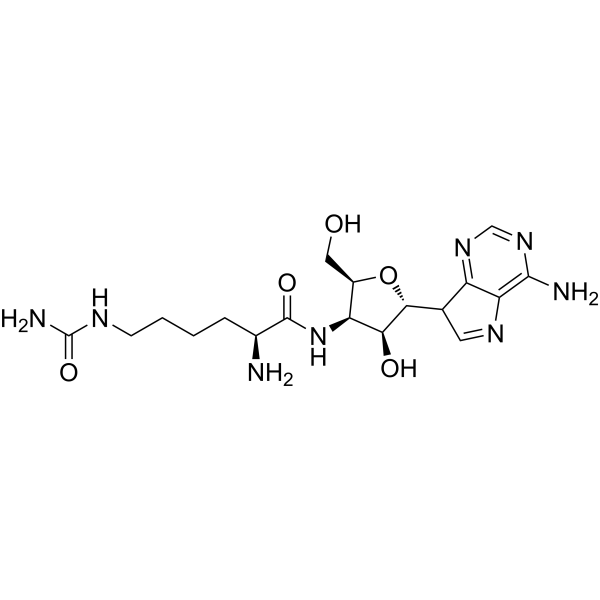 0 ImagesCat. No.: HY-N12612CAS No.: 59204-62-5CNP0296775 is an inhibitor of dengue virus methyltransferase (DENV MTase) that has the potential to disrupt the viral replication process.
-
CM-272 (Standard)
 0 ImagesCat. No.: HY-101925RCAS No.: 1846570-31-7CM-272 (Standard) is the analytical standard of CM-272 (HY-101925). This product is intended for research and analytical applications. CM-272 is a first-in-class, potent, selective, substrate-competitive and reversible dual G9a/DNA methyltransferases (DNMTs) inhibitor with antitumor activities. CM-272 inhibits G9a, DNMT1, DNMT3A, DNMT3B and GLP with IC50s of 8 nM, 382 nM, 85 nM, 1200 nM and 2 nM, respectively. CM-272 inhibits cell proliferation and promotes apoptosis, inducing IFN-stimulated genes and immunogenic cell death.
-
Levetiracetam-d3
 0 ImagesCat. No.: HY-B0106S1CAS No.: 1217851-16-5Synonyms: UCB L059-d3Levetiracetam-d3 is the deuterium labeled Levetiracetam. Levetiracetam, an antiepileptic agent, binds the synaptic vesicle protein SV2A. Levetiracetam enhances Temozolomide effect on glioblastoma stem cell proliferation and apoptosis. Levetiracetam modulates HDAC levels ultimately silencing MGMT, thus increasing Temozolomide effectiveness. A chemosensitizer agent.
-
O6-Benzylguanine sodium
 0 ImagesCat. No.: HY-W002585ACAS No.: 100994-97-6O6-Benzylguanine sodium is an orally active, blood-brain barrier-penetrant inhibitor of O6-methylguanine-DNA methyltransferase (MGMT/AGT). O6-Benzylguanine sodium modulates p53 and its downstream p21 and cyclins to induce cell cycle arrest and apoptosis, and on the other hand activates mTORC1/MAPK and other signaling pathways to induce cellular senescence by inhibiting intracellular MGMT. O6-Benzylguanine sodium is used in research related to various tumors, cellular senescence, and vascular smooth muscle dysfunction.
-
Bobcat339 (Standard)
 0 ImagesCat. No.: HY-111558RCAS No.: 2280037-51-4Bobcat339 (Standard) is the analytical standard of Bobcat339 (HY-111558). This product is intended for research and analytical applications. Bobcat339 is a potent and selective cytosine-based inhibitor of TET enzyme, with IC50s of 33 μM and 73 μM for TET1 and TET2, respectively. Bobcat339 is useful to the field of epigenetics and serves as a starting point for new therapeutics that target DNA methylation and gene transcription.
-
ZINC-1000507824
 0 ImagesCat. No.: HY-181963ZINC-1000507824 is a non-covalent reversible RNA cytosine-5 methyltransferase NSUN2 inhibitor. ZINC-1000507824 targets the SAM cofactor binding pocket of NSUN2 and forms stable NSUN2-ligand complexes. ZINC-1000507824 destabilizes oncogenic mRNAs encoding PI3K/AKT and MAPK/ERK pathway components, attenuates growth signals, reduces proliferative drive, and restores therapy sensitivity in cancer cells. ZINC-1000507824 can be used for the research of NSUN2-driven malignancies.
-
O6-Benzylguanine (Standard)
 0 ImagesO6-Benzylguanine Standard is the analytical standard of O6-Benzylguanine (HY-W002585). This product is intended for research and analytical applications. O6-Benzylguanine is an orally active, blood-brain barrier-penetrant inhibitor of O6-methylguanine-DNA methyltransferase (MGMT/AGT). O6-Benzylguanine modulates p53 and its downstream p21 and cyclins to induce cell cycle arrest and apoptosis, and on the other hand activates mTORC1/MAPK and other signaling pathways to induce cellular senescence by inhibiting intracellular MGMT. O6-Benzylguanine is used in research related to various tumors, cellular senescence, and vascular smooth muscle dysfunction.
-
O6BTG-C8-αGlu
 0 ImagesCat. No.: HY-13786CAS No.: 793035-88-8O6BTG-C8-αGlu is an O6-methylguanine-DNA methyltransferase (MGMT) inhibitor with an IC50 of 0.45 μM. At a concentration of 0.1 μM, O6BTG-C8-αGlu can completely inhibit MGMT in HeLaS3 cells. Even when applied chronically at high doses (up to 20 μM), it does not exhibit cytotoxicity. O6BTG-C8-αGlu is suitable for research on MGMT-related cancer diseases.
-
Hydralazine hydrochloride (Standard)
 0 ImagesHydralazine (hydrochloride) (Standard) is the analytical standard of Hydralazine (hydrochloride). This product is intended for research and analytical applications. Hydralazine hydrochloride is an orally active, blood-brain barrier-permeable DNA methyltransferase inhibitor with vasodilatory, arterial smooth muscle relaxant and hypotensive activities. Hydralazine hydrochloride reactivates silenced tumor suppressor genes via mediating DNA demethylation, while exerting neuroprotective and anti-inflammatory properties. Hydralazine hydrochloride inhibits NOS-2 (iNOS) and COX-2, and reduces the production of NO and PGEE2; meanwhile, Hydralazine hydrochloride scavenges reactive oxygen species and inhibits macrophage activation. Hydralazine hydrochloride alleviates motor dysfunction, neuropathic inflammatory pain, and formalin-induced somatic and emotional pain responses. In addition, Hydralazine hydrochloride directly induces DNA strand breaks and sister chromatid exchange, exhibiting certain mutagenic characteristics. Hydralazine hydrochloride has been widely used in studies on hypertension, various cancers (such as cervical cancer, leukemia), spinal cord injury and the mechanisms of inflammatory pain.
-
5-Azacytidine-15N4
 0 ImagesCat. No.: HY-W653970CAS No.: 2139283-40-0Synonyms: Azacitidine-15N4; 5-AzaC-15N4; Ladakamycin-15N45-Azacytidine-15N4 is 13C and 15N labeled 5-Azacytidine. 5-Azacytidine (Azacitidine; 5-AzaC; Ladakamycin) is a nucleoside analogue of cytidine that specifically inhibits DNA methylation. 5-Azacytidine is incorporated into DNA to covalently trap DNA methyltransferases and contributes to reverse epigenetic changes. 5-Azacytidine induces cell autophagy.




